Header is a structural element in Report Designer that appears at the top of the report and is used to display the report title or summary information. The Header is positioned at the top of the page in the report output and ensures the visual integrity of the report.
The Header element is used to display information relevant to the entire report, such as the report title, logo, date information, page number, or fixed description fields. Unlike the Header in UI Design, the Report Designer Header is not interaction-focused, but rather output and print-focused.
When Should You Use a Header?
The Header is preferred in the following scenarios:
To display the report title or description
To highlight the organization logo or report identity
To add the report date, report name, or fixed information fields
To standardize the report header in PDF and print outputs
Basic Behavior of the Header Element
The Header is positioned at the top of the report and maintains this position during output.
The Header is a container element. Different elements can be added to it.
The Header does not have its own action or data binding structure.
The Header content is static; it does not change based on user interaction.
Auto Resize
There is a common behavior that applies to Header, Footer, and Box elements:
When an element is dragged into these elements,
If the added content does not fit into the existing space,
The element's height (size) automatically expands.
This ensures:
No content overflow,
No need for manual height calculations,
Layout is preserved in print and PDF outputs.
Elements That Can Be Added to the Header
The following elements can be added to the header:
Label (text)
Image (logo or visual)
Icon
Divider
Box
Static Table
Since the header functions as the visual header of the report, it contains restrictions for interactive or data-driven elements.
Restrictions for the Header
QR Renderer and Barcode Renderer
The QR Renderer and Barcode Renderer elements:
Cannot be dragged into the Header and Footer.
These elements can only be used in the body area of the report.
This restriction is intended for situations where barcodes and QR codes typically need to be data-dependent and row-based.
Behavior Difference Between Header and Footer
Header and Footer have a special behavior in the report output:
Header appears on the first page of the report.
Footer appears on the last page of the report.
For example:
Suppose a dynamic Report Table is added to the report,
The table is split into 3 pages due to the amount of data.
In this case:
The Header appears only on page 1,
The Footer appears only on page 3 (the last page).
Thanks to this structure:
The report start and end information is clearly separated,
Repeated header/footer usage is prevented.
Report Header Concept
In Report Designer, the Header element is considered by the system as a Report Header.
Report Header:
Is different from the Header in UI Design,
Does not serve a navigation or interaction purpose,
Is a structural part of the report output.
Can have a height setting,
A border can be added,
It is shaped by the layout of the elements placed inside it.
Styling and Visual Settings
The visual layout of the Header is not done directly on the Header itself, but on the elements added to it.
The background color can be provided using Label or Box.
If a border is needed, it can be added to the Header.
Alignment and spacing are controlled by the layout settings of the inner elements.
Header Usage Scenario
In a reporting application, a Header (Report Header) area is used at the top of the report to clearly indicate the identity and purpose of the report presented to the user. This area collects the report title, company information, and basic summary information about the report in one place, making the report more understandable and professional.
In this scenario, the Header is used to display fixed information that does not change throughout the report, such as the report title, company logo, and report date. The Header content is independent of the dynamic data in the report body and only represents the header information of the report.
In the scenario:
The Header is positioned at the top of the report.
The Header area displays the report title and corporate identity.
The content is static and not dependent on user interaction.
The header content is displayed only on the first page of the report output.
Even if the dynamic tables in the body of the report increase the number of pages, the header does not repeat.
Step 1 – Adding the Header Element
Open the Report Designer module.
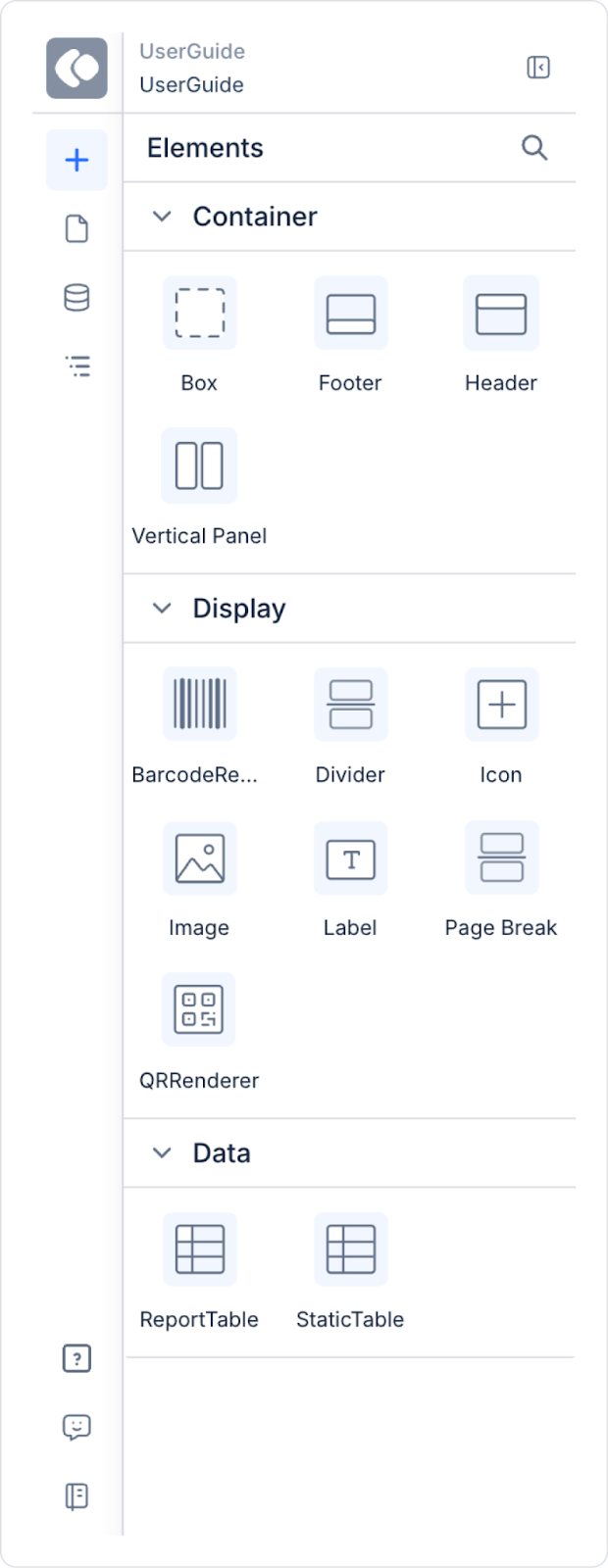
Select the Header element from the Elements area in the left panel.
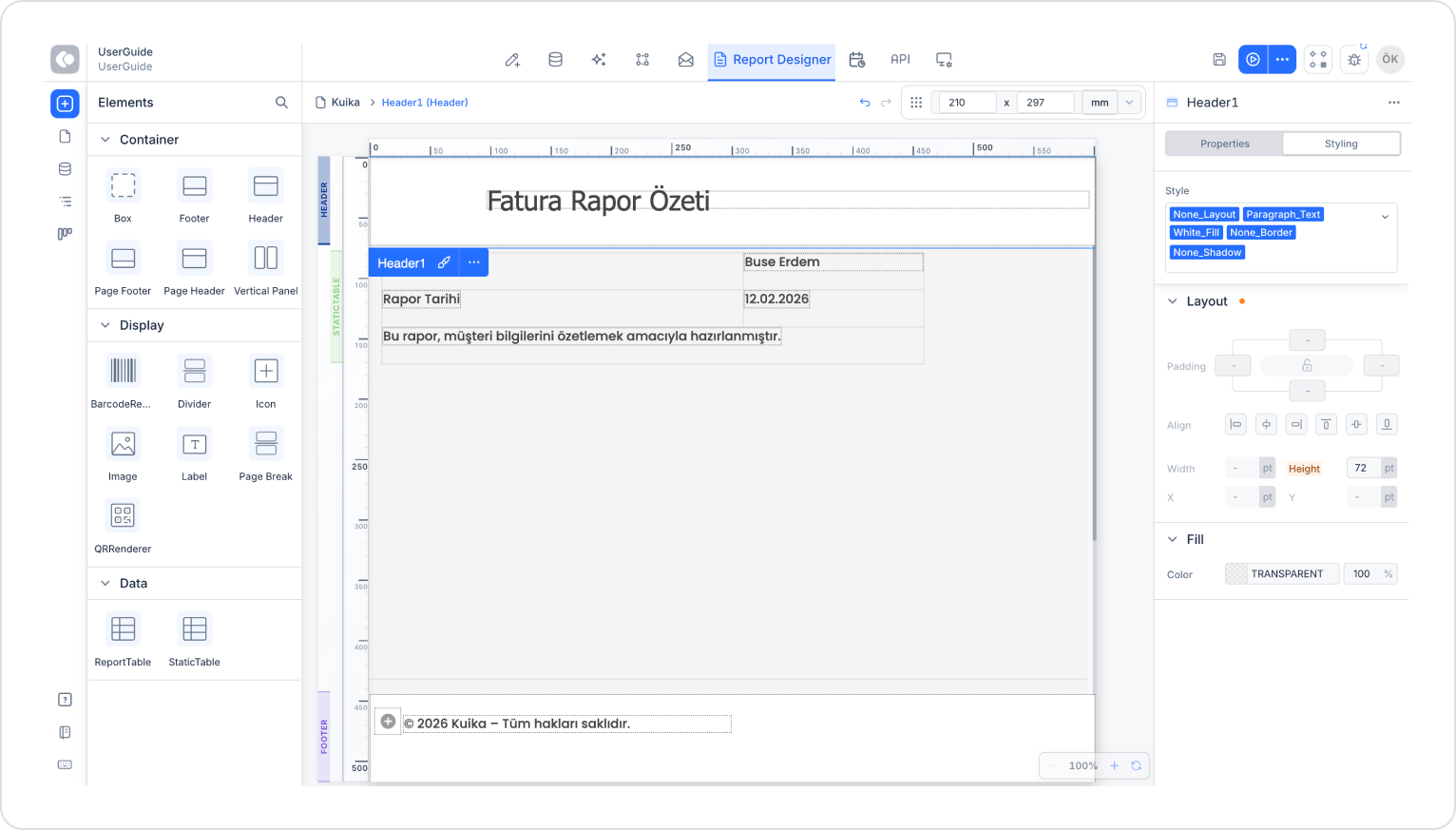
Drag and drop the Header onto the Canvas.
The Header is automatically placed at the top of the report and is considered a Report Header.
Step 2 – Creating Header Content
Drag a Label element into the Header.
Define the Label text as the report title. Example: “Invoice List Report”
Optional:
Add an Image element to place your company logo.
Add a second Label with the report date or description.
If the elements added to the Header do not fit in the available space, the Header height automatically expands.
Step 3 – Visual Editing
Separate the header area from the report body by adding a border to the header or its elements.
If necessary, use a Box to highlight the header background.
Adjust text alignment and spacing through the layout settings of the inner elements.
These adjustments make the report more readable at first glance.
Step 4 – Use with Dynamic Content
Add a Report Table or Static Table below the header.
The table can be split across multiple pages depending on the amount of data.
For example:
If the Report Table creates 3 pages due to the data:
The header is only displayed on the 1st page.
The footer (if any) is only placed on the last page.
This structure clearly separates the beginning and end of the report.
In this scenario:
A Report Header representing the report's header is created.
The header content is independent of and fixed relative to the report body.
In multi-page reports, the header appears only on the first page.
The report gains a more organized and professional appearance.